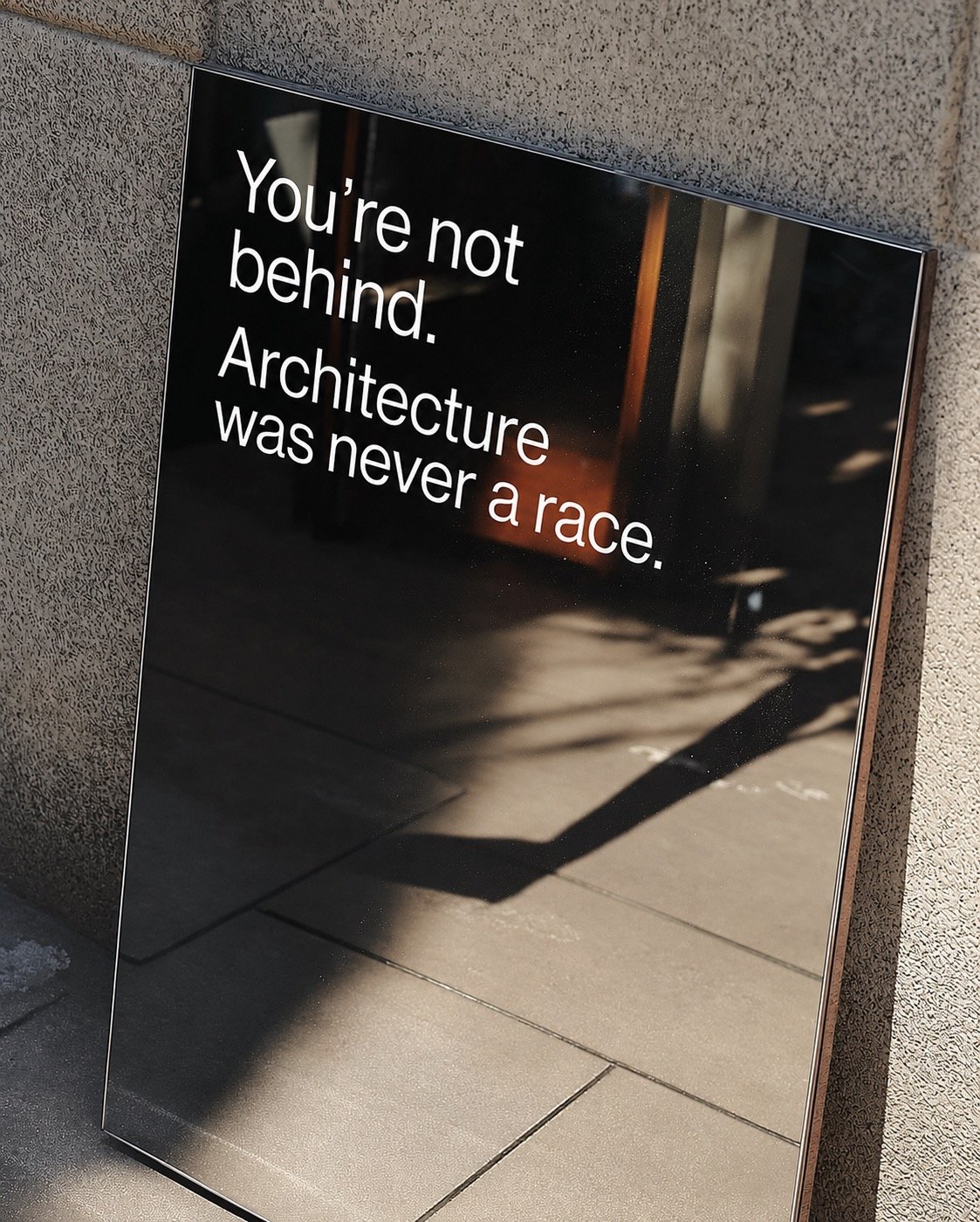
Your career isn't a checklist, and your success isn't determined by how quickly you reach the next milestone.
The Future of Architecture is You.
There is an unspoken timeline in architecture.
You feel it in school, when everyone seems to be competing for the strongest portfolio, the most impressive internship, or the highest recognition in studio. You feel it after graduation, when conversations shift toward job titles, professional experience, licensure, and the projects you've had the opportunity to work on. And you feel it as your career progresses, when the people around you begin reaching milestones that make you question whether you're moving quickly enough.
Architecture has a way of making progress feel measurable. There's always another skill to develop, another credential to earn, another responsibility to take on, or another level of professional recognition to pursue.
And while ambition can be a powerful motivator, it can also create the illusion that there is a correct sequence to building a successful career.
Graduate at the right time. Find the right firm. Gain the right experience. Become licensed. Earn a promotion. Lead a project. Eventually, become successful.
It's a reassuring narrative because it makes an uncertain future feel predictable. Follow the steps, work hard, and eventually you'll arrive where you're supposed to be. But careers rarely unfold that neatly, especially in a profession as complex and expansive as architecture.
Some people find their direction early. Others discover their strengths after years of trying different things. Some pursue traditional practice, while others find opportunities in adjacent disciplines they never knew existed when they entered architecture school. And somewhere between those different experiences, we begin comparing timelines that were never meant to be identical. We've been conditioned to mistake milestones as the only meaningful measure of progress.
Architecture Creates the Illusion of a Timeline
Architecture school introduces structure into an inherently creative and unpredictable process. You move through semesters, studio levels, reviews, and increasingly complex projects. Your development is evaluated through assignments, presentations, critiques, and the ability to demonstrate progress within a defined period of time.
There is value in that structure. It teaches discipline, accountability, and the importance of developing ideas within constraints. But it can also create expectations about what professional growth is supposed to look like.
You begin to associate progress with moving forward on a prescribed path. Each milestone becomes another indication that you're doing things correctly. The difficulty is that architecture school offers a relatively structured environment, while professional practice introduces a much broader range of possibilities, responsibilities, and circumstances.
The student who excels in conceptual design may discover that the realities of project delivery require an entirely different set of strengths. Someone who struggles with studio presentations may thrive in professional environments where collaboration, technical coordination, and long-term problem-solving become essential.
Others may discover that the aspects of architecture they find most compelling exist beyond traditional design practice. They may become interested in development, interiors, technology, research, construction, branding, business strategy, or the countless disciplines that influence how our built environment takes shape. These paths are not necessarily deviations from success. They are different expressions of what an architectural education makes possible.
Yet when the profession consistently emphasizes a familiar set of milestones, choosing another direction can feel like falling behind, even when that direction is more aligned with your interests and abilities. There is nothing wrong with following a traditional path. The problem is believing it's the only path worth following.
Feeling Behind Is Often a Sign You're Growing
There's a particular kind of discomfort that comes with questioning your direction.
You may have spent years working toward a specific version of your future, only to discover that the reality feels different from what you imagined. Perhaps the work isn't as fulfilling as you expected. Maybe your interests have shifted, or you've started to recognize strengths that don't fit neatly into the role you originally wanted.
You look around and see other people continuing forward, seemingly confident in their decisions, while you're reconsidering your own. It's easy to interpret that uncertainty as a lack of progress.
But sometimes, the people who feel behind are the ones beginning to ask the most important questions about their future. Is this the kind of work I want to spend my career doing? Am I pursuing this milestone because it matters to me, or because I've been taught that it should? What kind of professional environment allows me to do my best work? What kind of life do I want to build alongside my career? These questions can be uncomfortable because they challenge the assumptions that once gave your ambitions direction.
In a profession that values decisiveness, productivity, and visible progress, taking time to reflect can feel counterproductive. Pausing to reconsider your direction may seem like hesitation when everyone else appears to be moving forward. But reflection is not the opposite of progress.
Sometimes it takes experience to recognize what doesn't align with your values. Sometimes you need to work in an environment that isn't right for you to understand what you want from the next one. And sometimes the ambitions that motivated you at twenty no longer reflect the person you're becoming at thirty. That doesn't mean your earlier goals were wrong. They may have been exactly what you needed at that stage of your life.
Growth often requires reconsidering what you once believed to be certain.
Of course, questioning your direction doesn't automatically create clarity. Reflection becomes valuable when it leads to greater self-awareness and more intentional decisions. But giving yourself permission to ask difficult questions is an important place to begin. You are not necessarily falling behind because your path is changing. You may simply be developing a clearer understanding of where you want it to lead.
Architecture Doesn't Reward Speed Alone
Architecture is a profession that requires time.
Not simply time spent working, but time spent observing, questioning, making mistakes, resolving problems, and understanding the consequences of decisions. There are skills you can develop through education and technical training, but there are also forms of professional judgment that emerge only through experience.
You learn what happens when an idea encounters a budget. When a carefully considered design must respond to construction constraints. When a project changes direction because of circumstances outside your control. When a conversation with a client, consultant, or contractor reveals a consideration you hadn't anticipated. You learn that good architecture requires more than compelling ideas. It requires communication, collaboration, accountability, and an understanding of how countless decisions influence the final result.
Some people gain substantial technical experience early in their careers. Others become strong communicators, project managers, or strategic thinkers before developing the same level of technical expertise. Some find themselves working on complex projects immediately, while others spend years developing foundational skills before receiving similar opportunities. None of these experiences can be evaluated through speed alone.
The profession needs people with different strengths, perspectives, and areas of expertise. The ability to contribute meaningfully doesn't depend on everyone developing those abilities at the same pace. And while early accomplishments can create valuable opportunities, they are not guarantees of long-term fulfillment or professional success. A promotion may bring greater responsibility before someone feels prepared for it. A prestigious position may offer recognition without the kind of work that feels meaningful. A rapidly advancing career may leave little room to consider whether the direction still aligns with personal ambitions.
Progress is not simply the accumulation of titles, credentials, and completed projects. It’s also the development of judgment, perspective, confidence, and the ability to make increasingly thoughtful decisions about your work. Moving quickly can create momentum, but moving intentionally gives that momentum direction.
There Is More Than One Way to Build a Career in Architecture
One of the most limiting assumptions we inherit from architecture school is that an architectural education should lead to a narrowly defined professional outcome.
The traditional path into architectural practice is important. Licensure carries significant responsibilities, establishes professional qualifications, and creates opportunities to lead work that directly shapes the built environment. For many people, becoming a licensed architect is a meaningful and worthwhile goal. But it is not the only way an architectural education can create value.
Architecture teaches you to analyze complex problems, understand relationships between systems, communicate abstract ideas, and balance creative ambition with practical constraints. You learn to consider how people interact with their environments, how decisions influence one another, and how a concept moves from an initial idea toward something tangible. Those abilities extend into a wide range of disciplines. An architectural background can inform work in interior design, urban planning, development, construction, technology, research, business development, and leadership. These fields are not interchangeable, and each requires its own knowledge and expertise. But the foundation developed through architectural education can provide a valuable perspective within them.
Sometimes the most meaningful career opportunities emerge when you recognize that your strengths don't fit perfectly within the role you originally imagined. You may discover that you enjoy communicating design ideas more than producing them. That you're energized by understanding how projects are pursued and won, rather than focusing exclusively on how they're executed. That you have a natural ability to connect people, identify opportunities, or translate complex concepts into compelling narratives. Leaning into your strengths may reveal possibilities you were never encouraged to explore.
Choosing a different path doesn't necessarily mean abandoning architecture, i may mean contributing to the industry in a way that better reflects your abilities, interests, and ambitions. Your degree is a foundation, not a boundary. You’re allowed to build something different upon it.
You Are Not Late. You're Early in a Long Career.
When you're at the beginning of your career, every decision can feel disproportionately important: the first job, the first major project, the first promotion, the decision to pursue licensure, change firms, relocate, or explore another discipline. There's an underlying fear that choosing incorrectly will somehow place you permanently behind. But architecture is a profession that can unfold over decades.
The experience you gain at twenty-five may shape the decisions you make at thirty-five. The relationships you develop early in your career may create opportunities years later. The challenges that feel discouraging today may eventually become the experiences that inform your strongest professional judgment. Many of the qualities associated with effective architectural leadership take time to develop.
Understanding how to navigate competing priorities, communicate with different stakeholders, manage risk, and recognize the long-term implications of design decisions requires more than technical ability. It requires perspective which develops through exposure to different projects, people, environments, successes, and failures.
This doesn't mean you should postpone your ambitions or assume that meaningful contributions only happen later in life. Emerging professionals bring valuable ideas, technological fluency, and perspectives that can challenge established ways of thinking. But you don't need to accomplish everything early to build a meaningful career. You can take time to explore your interests, change your direction after discovering something new, and pursue opportunities that don't fit your original plan. You can also recognize that different seasons of life may require different professional priorities.
There may be years when you're focused on advancement, years when you're developing a particular skill, and years when maintaining balance outside of work becomes more important. A sustainable career has room for those changes. You are not running out of time simply because you haven't reached the milestones you once expected to achieve by now. You're building experience, perspective, and the capacity to make decisions that will shape the years ahead. And in a profession built around long-term impact, longevity matters.
Stop Comparing Careers That Were Never Meant to Be Identical
Comparison is particularly difficult in a profession where accomplishments are so visible.
You see someone announce their licensure. A former classmate receives an award. A colleague becomes a project manager. Someone you graduated with joins a firm you've admired for years. You celebrate their accomplishments, but somewhere in the back of your mind, you begin measuring your own progress against them. Should I be further along? Am I making the right decisions? Why does everyone else seem to know what they're doing?
Social media can intensify these feelings because it presents careers through selected moments of achievement. You see the completed projects, professional announcements, and exciting opportunities, but rarely the uncertainty, rejected applications, difficult transitions, or personal circumstances that shaped the journey. What looks like a straightforward progression from the outside may have involved years of experimentation, frustration, and reconsideration. And even when someone else's career has developed more quickly, that doesn't mean their path is the one you should be following. You may have different interests, responsibilities, financial circumstances, personal goals, or definitions of fulfillment. The position someone else is working toward may not even be one you would enjoy.
Comparison becomes particularly unhelpful when it causes you to pursue achievements simply because they appear to represent progress. Before measuring yourself against someone else's milestone, consider whether it's something you genuinely want. Would that responsibility excite you? Would that role align with your strengths? Would that opportunity support the kind of life you're trying to build? If the answer is no, then reaching it faster would not necessarily move you closer to success.
There is value in learning from the careers of people you admire. Their experiences can offer perspective, inspiration, and a better understanding of what may be possible. But inspiration should expand your sense of possibility, not narrow your definition of success. Someone else's accomplishments can be meaningful without becoming a measurement of your own worth.
Redefining What Progress Looks Like
If there is no universal timeline, how do you know whether you're making progress?
It's a reasonable question, particularly in a profession where so much of our development has traditionally been measured through clearly defined benchmarks. Milestones still matter. Completing a degree, earning a professional license, gaining new responsibilities, or contributing to a significant project can represent years of meaningful effort. But those accomplishments tell only part of the story.
Progress can also look like developing the confidence to ask questions in a room where you once remained silent. It can look like learning to advocate for your ideas, understanding the business behind design, or becoming someone your colleagues trust to navigate a difficult situation. It can mean recognizing that an environment is no longer helping you grow and having the courage to pursue something different. Sometimes progress is taking on greater responsibility. Other times, it's learning to establish boundaries so you can sustain your energy and creativity over the course of a long career. And sometimes progress is simply becoming more honest with yourself about what you want.
These changes may not result in immediate recognition. They may not appear on a résumé or translate into a new job title. But they influence the way you approach opportunities, make decisions, and contribute to the work around you. Instead of asking only whether you're moving quickly enough, consider asking whether you're moving with greater awareness.
Are you developing skills that matter to you? Are you learning from the experiences you're having? Are you becoming more confident in your judgment and more intentional about the opportunities you pursue? Are you building a career that supports the life you want outside of work? The answers may change over time, and that's part of the process. Progress isn't always about reaching the next milestone. Sometimes it's about understanding which milestones are worth pursuing in the first place.
If You Take One Thing From This
You do not need to follow someone else's timeline to build a meaningful career in architecture.
You don't need to graduate at the same age, become licensed at the same pace, pursue the same opportunities, or measure success through the same accomplishments. You are allowed to explore. To reconsider. To discover interests you didn't know you had. To pursue opportunities that challenge the expectations you once held for yourself. You are allowed to take your career seriously without treating every decision as permanent or every milestone as urgent.
Architecture is a profession shaped by different disciplines, perspectives, and ways of thinking. Its future depends not on everyone following the same path, but on people bringing their individual strengths and experiences into the work. And the same should be true of the careers we build within it. The goal isn't to eliminate ambition or stop pursuing meaningful accomplishments. It's to become more intentional about what you're working toward and why those goals matter to you. There is a difference between building a career that looks successful and building one that feels meaningful.
One is often measured through external recognition. The other requires understanding your own values, interests, and priorities. Ideally, the two can exist together. But when they don't, you should feel empowered to question which definition of success you're following.
So if you're feeling behind, uncertain, or frustrated that your career doesn't resemble the path you imagined, remember that you're still developing the perspective that will shape what comes next. You have time to learn. Time to grow. Time to discover strengths you haven't fully recognized and opportunities you haven't encountered yet. You don't need to know exactly where you'll end up to make thoughtful decisions about where you're going.
You are not late to a future that was never supposed to follow someone else's timeline. The most meaningful part of building a career in architecture is realizing that you have the ability to design your own.
The Future of Architecture Is You.
Explore EmbArc for honest conversations, fresh perspectives, and real experiences navigating architecture, design, career growth, and everything in between. A space for those finding their way, questioning what's next, and redefining what success looks like along the way.